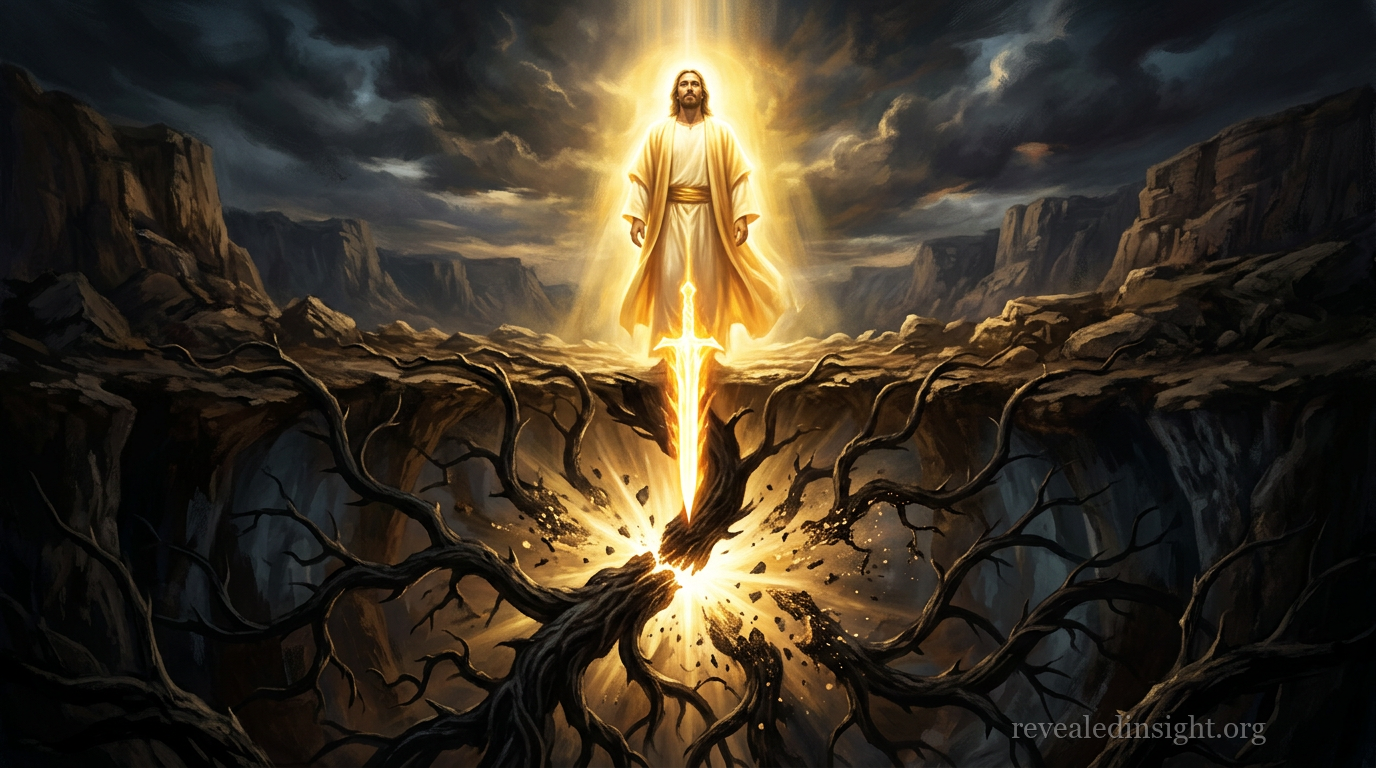
Breaking Yokes Pt. 3: Responsibility, Honor, and the Root of Bondage
True freedom begins not with rebuking the enemy, but with taking personal responsibility and honoring where honor is due.
Yokes of bondage are rarely broken by addressing symptoms alone — the root must be confronted. This teaching cuts through the surface level of spiritual struggle to expose the personal decisions, patterns of blame, unresolved offense, and emotional disorder that keep believers locked in bondage — and reveals why God's will is complete, uncompromised freedom.
Teaching Overview
- Yokes must be addressed at the root, not merely at the symptom level — removing a yoke without dealing with its cause leaves the underlying burden in place.
- Blame-shifting, victimhood, and emotional decision-making are definitive signs of living under a yoke of bondage.
- Refusing to honor where honor is due is itself a form of bondage that blocks blessing and keeps the believer perpetually beneath.
- Taking personal responsibility — including for decisions made under pressure — is the foundation of genuine repentance and the pathway to breaking yokes.
- It is the will of God for every believer to be completely free from all kinds of bondage.
Key Distinctions
| Bondage vs Freedom | Symptom vs Root Problem | Emotional Decision-Making vs Rational Decision-Making | Honor to God vs Honor to Man | Serving God vs Serving Satan's Interests | |
|---|---|---|---|---|---|
| What it is | Being made a servant to someone else's interests without compensation vs mutual service in Christ | The visible burden felt vs the underlying cause producing it | Decisions driven by uncontrolled feeling vs informed, conscious choice | Worship directed to the Creator vs worship due to human authority in its proper place | Mutual bond with God where both serve one another vs unpaid servitude to an agenda that works against you |
| Who it involves | The believer bound to another's agenda vs the believer joined with God in mutual service | The ox carrying the yoke vs the one who placed it and demands the ground be plowed | The believer whose mind has been blinded vs the believer walking in discernment | God, who commands honor be given where it is due, and man, who remains capable of error | God, who gives ten times more than is received, vs Satan, who gives no compensation |
| How it manifests | No advancement, no promotion, perpetual uphill battle | Tiredness, drag, sorrow added to blessing | Always ending up in greater problems than before | Either robbing God by giving His honor to man, or robbing man by withholding deserved honor | Freedom in Christ with no slave relationship vs being someone's ox — used, unpaid, and unrecognized |
| What enables it | Blame, offense, dishonor, emotional disorder | Treating the yoke as the problem rather than the burden behind it | The devil blinding the mind so informed decisions become impossible | Misunderstanding that honor — the same Hebrew and Greek word as worship — has rightful human and divine applications | Decisions made under pressure without personal accountability |
| How it is broken | Taking responsibility, releasing offense, honoring rightly, dealing with root causes | Identifying and confronting what is driving the yoke, not just its visible effects | Returning to conscious, rational, Spirit-led decision-making | Restoring the balance — giving God what belongs to God and giving man what belongs to man | Aligning with God's will, which is complete freedom from all bondage |
The Difference Between Yoke and Burden
- A yoke is the labor carried out because of the burden that has been placed on a person.
- The yoke itself is not the deepest problem — what drives the yoke is the burden of the one who placed it there.
- Removing the yoke without dealing with the burden beneath it is treating a symptom, not the root.
"We want to not only deal with symptoms. We want to deal with the root of the problem. As a child of God, your desire must always be to deal with the root of the problem."
Signs of Living Under a Yoke
- Feeling dragged down, tired without cause, and in a consistent uphill battle are indicators that a yoke is at work.
- The blessing of the Lord is meant to make rich and add no sorrow — when sorrow keeps being added, something is operating in the background.
- Lack of promotion over years of work is a concrete, observable sign of bondage.
"You've been working for 50 years, 30 years, 10 years, no promotion. You're under bondage. You're somebody's ox."
Blame-Shifting as a Yoke
- Blaming others for personal errors is a definitive sign of living under a yoke.
- Esau blamed Jacob for stealing his birthright, but Esau made a conscious exchange — he sold it for food when he was not truly in mortal danger.
- Blaming ancestors, circumstances, or other people for one's condition, while making no decision to change, is a deep yoke in itself.
"Some of you the reason why you cannot rebuke or break your yokes because you are still blaming the enemy for your misdoings, your misdecisions you made under the enemy."
Repentance and Personal Responsibility
- True repentance requires understanding where one personally went wrong — this is not a small part of repentance, it is the biggest and only part.
- God does not excuse decisions by pointing to external pressure — He examines what decisions were made under the pressure.
- The "somebody made me" excuse does not exist before God and is itself a yoke that opens the door to deeper bondage.
"You see part of repentance is understanding where you went wrong. It is the biggest part and it is the only part in repentance."
Offense as a Form of Bondage
- Being easily offended is a sign of living under bondage — the offended person is serving the one who offended them.
- The person who caused offense may be sleeping peacefully and have forgotten entirely what they did, while the offended person remains enslaved to the memory.
- Spiritual bondage rooted in offense runs even deeper than natural bondage — the Bible addresses both the offender and the offended.
"If you're under bondage because of offense, imagine the bondage you are spiritually. The bondage you are in spiritual is even deeper."
Emotional Decision-Making as Evidence of Bondage
- People under a yoke make every decision emotionally, not rationally — the devil blinds the mind to prevent informed, conscious decisions.
- Emotionally-driven decisions consistently produce greater problems than the ones they were meant to solve.
- Emotions are not evil in themselves, but when they control rather than inform, they are a sign of bondage.
"People who are under yoke, not only do they blame others, they make every decision emotionally, not rationally. The devil has blinded their mind to be able to make conscious decisions, informed decisions, they can't."
Bondage, Service, and Freedom in Christ
- The word "bondage" in old English is rooted in "bond" and "servant" — to be in bondage is to be made a servant to another's interests.
- God Himself serves — He protects, provides, and answers — which means believers who serve are doing what God does, not something beneath them.
- In Christ, there is no slave — all are made free, because what believers do for God, God returns ten times more.
"There is no slave in Christ. We are all made free. Because what we do and to God, God has done it ten times more and to us. But when you are in bondage, you are serving somebody else's interest without any compensation."
What Controls Your Life
- Identifying what is running and controlling one's life is a means of discerning whether bondage is present.
- Carrying church hurt and making it the lens of life means a person is bound to the people who hurt them, not to God.
- People and institutions can become God to a person — traps for enslavement — when they are given authority they were never meant to hold.
"If you understand somebody is a man and a man can make mistakes, a woman can make mistakes. But another man does you wrong even though they are men of God. You take it to heart. It means you are bound to them. You are not bound by what you are in bondage. They have become God to you."
The Meaning of Honor and Its Rightful Place
- The word "honor" in both Hebrew and Greek means worship — but the honor given to God and the honor given to man are distinct in kind.
- When Jesus was asked about taxes, He distinguished between what belongs to Caesar and what belongs to God — the error is giving what belongs to God to man, or withholding from man what is rightly due.
- Dishonoring someone God has blessed — undermining, ridiculing, refusing to acknowledge — is a deep yoke that blocks the blessing of God from operating in one's own life.
"If you cannot honour, you're under bondage. It means you have robbed yourself of the ability to be honoured. It means you will always be below. It means you will always be under."
Job: The Model of Yoke-Free Living
- Job, the most powerful man in the Old Testament era, never blamed anyone for what happened to him.
- He was free from condemnation and free from the yoke of Satan — the only one he answered to was God.
- Job's posture stands as the standard: do not allow Satan to maneuver a believer into cursing God and entering deeper bondage.
"Don't allow Satan to put you in a position you curse God and you find yourself in deeper bondage. Don't allow the devil to put you in a place whereby you offend God and you are in deeper bondage."
God's Will Is Complete Freedom
- It is the will of God for every believer to be completely free from all kinds of bondage — not partially free, not managing bondage, but completely free.
- God is able to release believers from anything Satan assembles for their destruction.
- The truth of God brings liberation — and believing that truth is the beginning of walking in it.
"It is the will of God for you to be completely free from all kinds of bondage. It is truly the will of God."
Key Definitions
Yoke — The labor carried out because of a burden placed on a person by another; the visible effect of an underlying demand being made upon one's life.
Bondage — Derived from the old English words "bond" and "servant"; a state in which a person has been made a servant to another's interests without compensation, choice, or freedom.
Root Problem — The underlying cause driving a yoke, as distinct from the symptom; the demand or force behind the visible burden that must be addressed for true freedom to come.
Honor — The Hebrew and Greek word for honor carries the meaning of worship; it is properly directed toward God in one measure and toward man in its rightful, lesser measure — and to withhold it from either is to violate the order God has established.
Repentance — Not merely remorse, but the act of identifying exactly where one went wrong and taking personal responsibility for decisions made — including decisions made under pressure.
Emotional Decision-Making — A sign of bondage in which the mind has been blinded by the enemy to the point where informed, rational, conscious decisions can no longer be made — every choice is driven by feeling rather than truth.
Key Takeaways
- Yokes must be broken at the root, not just at the symptom — treating only what is visible leaves the burden that produced the yoke fully intact and capable of placing another yoke immediately.
- Blame-shifting is not just a character flaw — it is a yoke — as long as responsibility is assigned to others for one's own decisions, there is no ground from which to break free.
- Refusing to honor where honor is due keeps a believer perpetually beneath — dishonoring those God has blessed blocks the flow of blessing and locks a person in a cycle of remaining under rather than rising above.
- God's will is not partial freedom but complete freedom from all bondage — settling for management of bondage rather than total liberation is settling for less than what God has declared.
- Personal responsibility is the foundation of genuine repentance — without identifying where one personally went wrong, there is no true repentance, and without repentance, the yoke cannot be broken.
Reflection Questions
- What burdens are you currently pulling that you have attributed to external forces — and what personal decisions, made under pressure, may have opened the door to them?
- Is there a person, a church, or an experience you are still carrying offense toward? What does it reveal about who or what you are actually bound to?
- When you face difficulty, is your first instinct to identify what someone else did — or to examine what decision you made? What would change if you began with personal responsibility?
- Who in your life deserves honor that you have withheld — and is that refusal costing you something in your own blessing and position?
- Do your decisions come from a place of rational, Spirit-led discernment, or are they consistently driven by emotion? What is one area where emotional decision-making has repeatedly led you into greater problems?
Prayers and Declarations
"Every man of disorder, be removed. Thank you, Father, for complete restoration."
Scripture References
- Genesis 27:32–37
Golden Nuggets
"We want to not only deal with symptoms. We want to deal with the root of the problem. As a child of God, your desire must always be to deal with the root of the problem."
"People who are under yoke, not only do they blame others, they make every decision emotionally, not rationally. The devil has blinded their mind to be able to make conscious decisions, informed decisions, they can't."
"When you are in bondage, you are serving somebody else's interest without any compensation."
"There is no slave in Christ. We are all made free. Because what we do and to God, God has done it ten times more and to us."
"Part of repentance is understanding where you went wrong. It is the biggest part and it is the only part in repentance."
"If you cannot honour, you're under bondage. It means you have robbed yourself of the ability to be honoured. It means you will always be below. It means you will always be under."
"Don't allow Satan to put you in a position you curse God and you find yourself in deeper bondage."
"It is the will of God for you to be completely free from all kinds of bondage. It is truly the will of God."
"Give Caesar what belongs to Caesar and give God what belongs to God. The problem is you give the honour of God to man. And the honour of man you give to God."
Resources and Further Reading
Quote card — tap to view & save
Mobile & desktop wallpapers — tap to download
Related Teachings
Share this teaching
Share the Word
If this message has blessed you, you can help make Scripture accessible to others around the world.
